

A Brief Testimonial on the Occasion of the 60 th Anniversary of Bob Moog’s Historic AES Presentation on his Prototype Voltage-Controlled Modular System
By Albert Glinsky, author of Switched On: Bob Moog and the Synthesizer Revolution ,Oxford University Press, 2022
Sixty years ago this week, Robert Arthur Moog, a shy, unassuming young man of 30, not generally known to anyone outside the world of theremin kits, sat at his little AES display at the Barbizon-Plaza Hotel in Manhattan, his table draped with his wife’s Indian print bedspread. Sitting atop it was his self-described “Abominatron”—four handmade modules with sheet metal panels hastily spray-painted, with jacks and knobs identified only by paper labels stuck on with rubber cement.
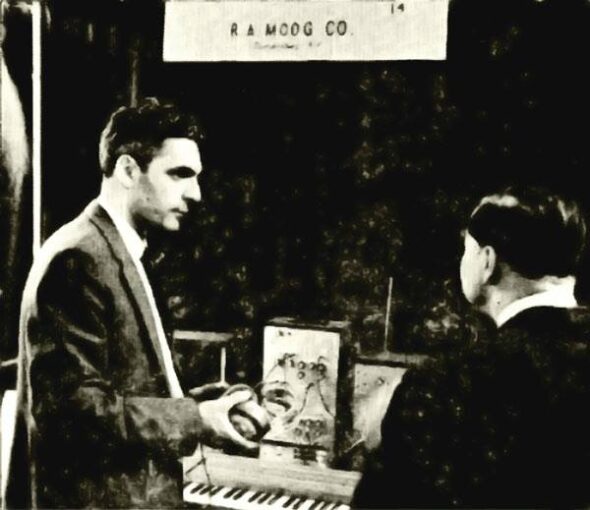
Bob Moog at his AES booth in 1964, with the “Abominatron” close by.
He was surrounded on all sides by the titans of the audio electronics industry: Ampex, Scully, 3M. It was intimidating to a fault; he sat, hoping a few
passersby would care to don a pair of earphones to sample the aural cherry pies or pumpkins of his State Fair-like presentation—a pleasant curiosity at best, he figured. Then something unexpected happened. As he famously recalled, a prominent visitor approached and uttered the words, “I’d like a couple of these and a couple of these.” He was in business, and he hadn’t planned on anything like that. History was made right then and there.
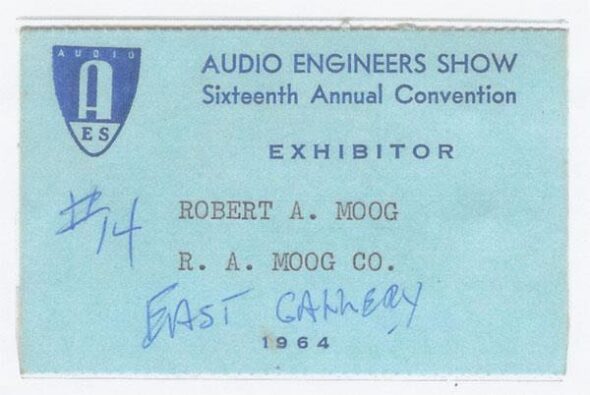
During this same 16th Annual AES convention week, on Wednesday, October 14 th, at 9:30 in the morning, a session titled, MUSIC AND ELECTRONICS was chaired by the venerable Harald Bode. The second presenter of the morning, a certain Robert A. Moog of the R. A. Moog Company of Trumansburg NY, strode to the podium and read a 9-page typed manuscript titled, “Voltage-Controlled Electronic Music Modules.”
Footnotes at the bottom of his last page credited a few predecessors on whose giants’ shoulders he felt he was standing—figures like Myron Schaeffer, Hugh LeCaine, and Bode himself. And the crowd was formidable: Le Caine was there, Bode, of course, and Harry F. Olson and Herbert Belar, inventors of the already classic RCA Mark I and Mark II synthesizers.
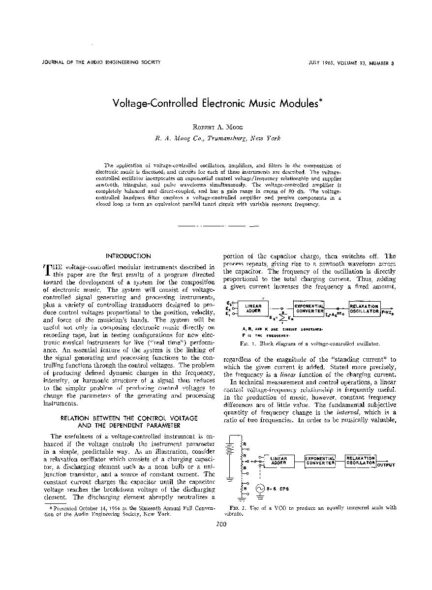
After the convention, Bob began selling custom variations on his prototype modules, and the rest, of course became history. But what some may not realize—something that really struck me as Bob’s biographer—is the influence, not just of the instruments themselves, but of Bob’s generosity in sharing the “recipe,” as I like to call it, for this groundbreaking system that would revolutionize music and sound art. Less than a year after his AES presentation, Bob published a detailed 7-page article in the July 1965 issue of the Journal of the Audio Engineering Society, replete with generous block diagrams, schematics, and photos. In the proprietary world of our current technology, this selfless, open-source act is astounding. Not that others
hadn’t done this sort of thing before, and Bob had certainly come of age in the world of hobbyist magazines, DIY projects, and the brotherhood of tinkerers. But with the commercial potential of Bob’s system, it fairly gave the whole game away. Bob had inadvertently presented his own giant’s shoulders to the world, upon which so many others would stand—some eventually acknowledging the pedestal on which they held their own inventions, some not.
But then, Bob’s passion was sheer invention, and often, as we know, to the detriment of profit and the big picture. But that was Bob: generosity of spirit, and the delight of scattering his seeds widely, even if some of it occasionally took root in competitors’ pastures. It’s not a stretch to say, and I say it with full confidence and conviction based on the facts: Buchla, ARP, EMS, and numerous others that followed—none of them would have been possible without Bob’s published recipe. The timeline bears it out, and some have openly admitted it.
The seminal genius of Bob’s work (and there are so many aspects to it), might be summed up by two statements he made in his AES talk that October morning in 1964. After citing several early historical attempts at producing music electronically, he explained, “The failure of any of these instruments to attain widespread success can be attributed at least partially, to the limitation on the degree of control which the performer is able to exercise over the instrument’s sounds.” He concluded his paper by saying, “In particular, the setting up of prototype experimental musical instruments, and the remote-control processing of conventional audio signals are ideal applications for the voltage-controlled modules.”
Ideal indeed!! Amen Bob. And what a legacy you’ve left us. Thank you, and congratulations on such a rich 60-year legacy!!
Albert Glinsky
10/7/24
You can purchase Switched-On: Bob Moog and the Synthesizer Revolution here.