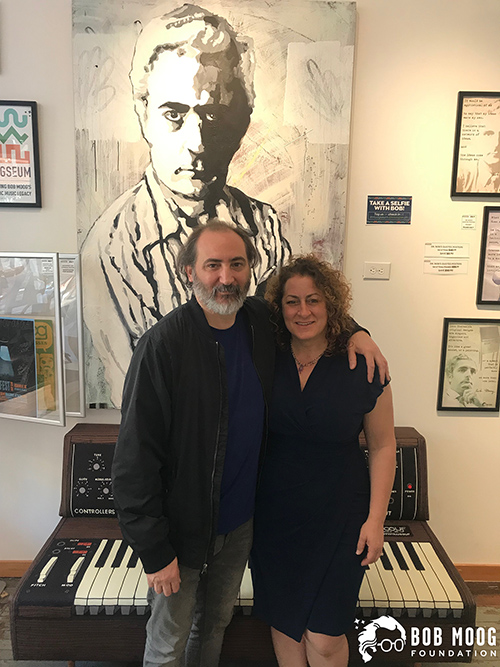
Michelle Moog-Koussa didn’t know much about her famous father’s legacy until Robert Moog, inventor of the the first commercial synthesizer, died in 2005.
“My father always held his career at arm’s length from the family, so I had very, very little exposure to ‘Bob Moog’ as a kid and even as an adult,” she says. “When he was sick, and when he passed away, we received thousands of testimonials from people all over the world attesting to how he had changed or even transformed their lives.”

For three days in mid-August, dozens of synthusiasts gathered in Asheville, North Carolina, to celebrate the grand opening of the Moogseum, a museum dedicated to Bob Moog’s life and accomplishments.

It was this revelation of his reach and impact on so many people that motivated Michelle Moog-Koussa and her family to form the Bob Moog Foundation. Now in its 13th year, the BMF honors Bob Moog through its stated mission “to ignite creativity at the intersection of music, science, history and innovation.”

Robert Arthur Moog, better known as Bob, was an American engineer best known for his work with synthesizers and electronic music. Moog didn’t invent the synthesizer, but he did revolutionize it. Before Bob, synthesizers were huge, unwieldy machines that took up an entire room and cost far too much to make them commercially viable.