

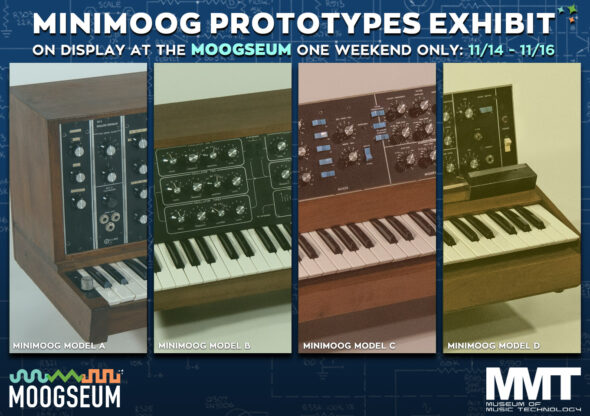
We are excited to announce a weekend-long exhibit of four Minimoog prototypes at the Moogseum, located in Asheville, NC. The exhibit is offered in partnership with the Museum of Music Technology (MMT), which proudly stewards the prototypes as part of its vast collection of synthesizers and other music technology in Harleysville, Pennsylvania. The temporary exhibit will take place over one weekend, from Thursday November 14 – Sunday November 16, 2025, marking the 55th anniversary of the first Minimoog being shipped on November 19,1970.
Members of the MMT staff will be on hand to answer questions about the prototypes. Tickets are $16 per person. The Moogseum is extending its hours to accommodate the interest in the exhibit, and will be open from 10-6 all three days. Advance ticket reservations are strongly encouraged.

Morning Tours with Michelle Moog-Koussa
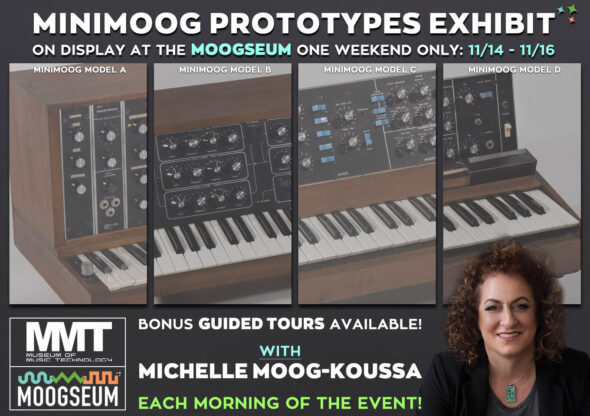
The Moogseum is also offering guided tours of the main gallery of the Moogseum at 9 am each morning of the special exhibit with Michelle Moog-Koussa, Executive Director of the Bob Moog Foundation and the Moogseum. The tours will focus on the Minimoog sections of the existing exhibits, offering a deeper dive into the iconic synthesizer. Tickets for the tours are $10 and are only open to ticket holders of the Minimoog Prototype Exhibit.
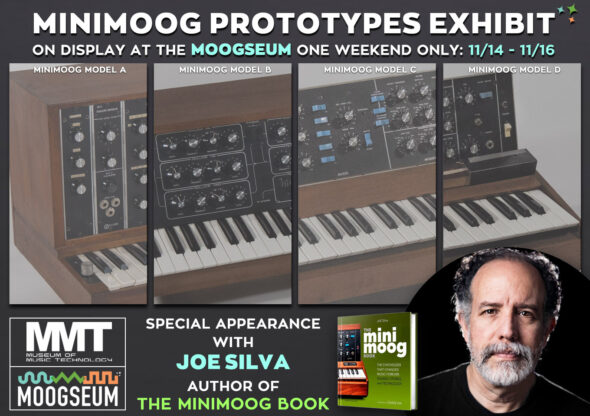
Additionally, JoE Silva, author of Bjooks’ The Minimoog Book will be on hand throughout the weekend to lend insights about the history and evolution of the Minimoog, and to sign books in the Moogseum store.
The Minimoog, first released in 1970, is widely regarded as one of the most iconic analog synthesizers of all times. With its robust sound, elegant interface, and roadworthy build, the Minimoog went on to sell 12,269 units between 1970-1982. It’s early adopters spanned genres and included Mother Mallard’s Portable Masterpiece, Sun Ra, Dick Hyman, Rick Wakeman (Yes), Herbie Hancock, Stevie Wonder, Geddy Lee (Rush), Keith Emerson (Emerson, Lake and Palmer), Chick Corea, Bernie Worell (Parliament Funkadelic) Jan Hammer, George Duke, Billy Joel, Manfredd Mann, Paul and Linda McCartney, Gary Numan, Kraftwerk, and many others.
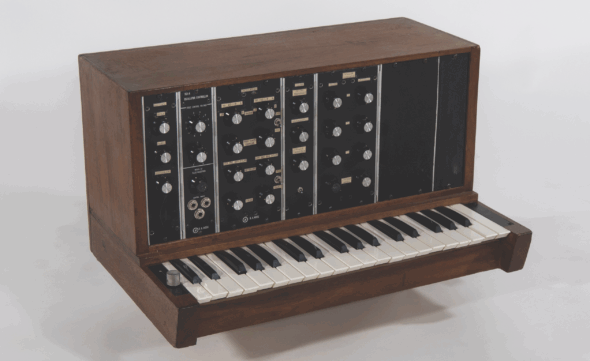
The Minimoog began in 1969 as the “Min A”, a five-module unit created by R.A. Moog Co. engineer, Bill Hemsath to provide easy demonstrations for the larger famed Moog modular systems.
The portability of the unit generated such appeal that Hemsath, along with fellow engineers Jim Scott and Chad Hunt, created the Model B prototype, which used circuit boards from the modular, housed under an integrated front panel designed by Hemsath. It included three identical oscillator sections; noise, filter, and master tuning sections; amplitude and filter contour controls, as well as a front-mounted power switch, and it came with a fitted lid with a handle that clipped on the top of the synthesizer for ease of portability.
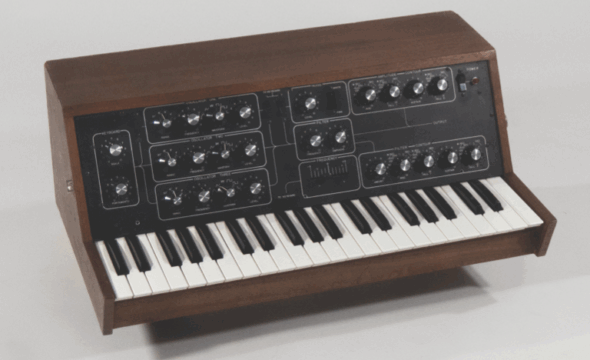
The Model C prototype was the first prototype to replace existing circuits from the modulars with new circuit designs which were simplified and adapted for the portable system. Its panel design shows significant evidence of Bob Moog’s involvement as he added the all-important rocker switches, among other aspects, as well as specifying the cabinet with its signature fold-down panel, to enhance portability.
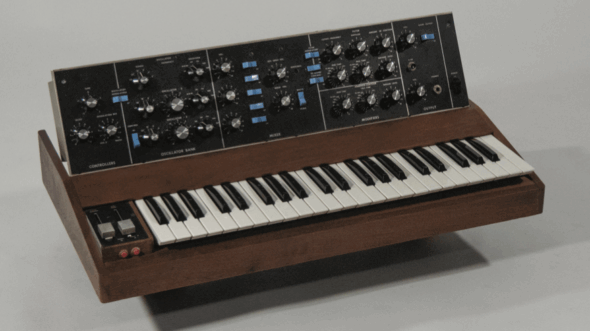
The Model D prototype had a few cosmetic tweaks to the front panel design to ready it for production, and design progressed to printed circuit boards with copper traces that could be mass produced. The A440 tuning reference replaced the momentary pushbutton with a rocker switch. Wood trim was added to the top of the control panel, and most importantly, the left hand controller sliders were replaced with wheels per Bob’s instruction, which allowed for more human nuance.
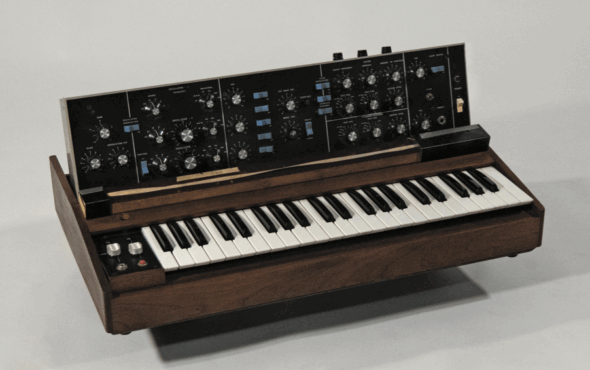
“The Bob Moog Foundation is thrilled to be sharing the storied history of the legendary Minimoog through this weekend-long exhibit,” noted Michelle Moog-Koussa, Executive Director of the Bob Moog Foundation. “This will mark the first time that all four prototypes are exhibited together at a museum outside of the Museum of Music Technology. The exhibit will trace the rich history of this seminal instrument that helped bring synthesis to the gigging musician, and through them to a world of music enthusiasts.”
The Electronic Music Education and Preservation Project (EMEAPP) is a nonprofit organization dedicated to preserving, studying, and celebrating the instruments, technology, and history that shaped the evolution of electronic music. At the heart of this mission is the Museum of Music Technology, a public-facing initiative that brings EMEAPP’s vast collection to life. Opening to visitors in late November, the museum will showcase interactive exhibits, rare artifacts, and immersive experiences designed to inspire musicians, students, historians, and enthusiasts alike. By bridging past, present, and future, the Museum of Music Technology invites visitors to explore the groundbreaking inventions that defined electronic music and to witness firsthand the tools that continue to spark creativity in today’s music and sound industries.
“We are honored to help preserve and share Bob Moog’s legacy by bringing the Minimoog prototypes into public view,” noted Vince Pupillo, Sr, Founder and President of EMEAPP. “We value the important work of the Bob Moog Foundation and are grateful for the chance to share these wonderful artifacts with the Moogseum’s guests.”
The MMT is also bringing Minimoog serial number 1016 (the sixteenth Minimoog, produced in early 1971) for exhibit attendees to play. This very special Minimoog was the first Minimoog owned by Minimoog super salesman David VanKoevering. If you don’t know about Dave’s pivotal role in bringing the Minimoog to musicians, you can read more here.

Screenshot
To learn more about the Moogseum and to purchase tickets for the November 14–16 Minimoog Prototype Exhibit, please visit https://bit.ly/MinimoogPrototypeExhibit