


The Moogseum is proud to announce Fifty Years of Bob Moog Theremins, an additional three-part digital exhibit highlighting the importance of the theremin in Bob Moog’s life and work, to their Google Arts and Culture’s Music Makers & Machines exhibition. Released the day after the anniversary of Leon Theremin’s death, the new exhibit pays tribute to him and the inspirational force that Theremin was in Bob’s life, with historical narrative written by Mike Buffington and Andrew Baron of RCATheremin.com.

Bob Moog built his first simple theremin from a do-it-yourself magazine article at age 14, and at age 19 in 1954, had his design published in the same publication. Moog’s Model 201 theremin design was a more refined version than the original DIY theremin, and although only about 20 assembled Model 201s were sold, this launched his company RAMCO/R.A. Moog with a higher demand on theremin kits and parts. These early assembled theremins were constructed with his father, George Conrad Moog, who made the wooden cabinets while Bob hand-assembled all of the components.

Fifty Years of Bob Moog Theremins explores the many different models of theremins that Bob created in his expansive career, weaves in manuals and schematics, and features rare photos and video clips. Organized into three parts, The Birth of Moog Theremins leads with the early years 1953-1956, Bob’s love of learning and affinity for the craft of building musical instruments.

Part 2, The Evolution of Moog Theremins 1957-1964 continues the journey as model numbers such as 305 and 351 were superseded by names like Vanguard and Professional, and Bob’s instruments embraced the latest transistorized “solid state” technology.
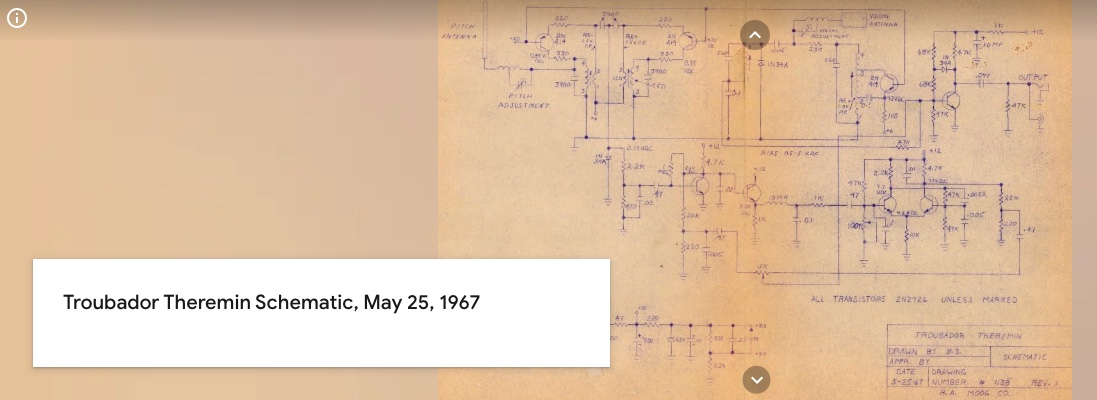
As in earlier years, Bob offered two price points, making the “Professional” model available with additional functions like timbre control.

The Big Briar Theremin Years and Beyond final section explores 1978-2004 with the theremin as a main source of inspiration for Big Briar’s goals of “…designing and building electronic and computer music controllers, as well as musical instruments and systems using electronic and computer technology.” This section includes the addition of MIDI and some of the newer technologies of the day, and the design of the Etherwave Pro, the final theremin designed by Bob.

Google Arts & Culture’s Music, Makers & Machines features exhibits from 55 partner museums and non-profits from around the world, sharing historical and educational artifacts from their vast collections. The Moogseum created 13 original exhibits, sharing over 275 pieces of material from the Bob Moog Foundation Archives.
Explore Music, Makers, and Machines: g.co/musicmakersmachines
Explore the Moogseum’s exhibits: https://artsandculture.google.com/partner/moogseum
In alignment with its mission to bring the pioneering legacy of Bob Moog alive for people of all ages, the Moogseum is sharing exhibits that explore Bob Moog’s life and career; evolutions in synthesis over a 100-year period; the history of Moog synthesizers; the use of Moog synthesizers in pop, rock, funk, jazz, and early pioneering works; the fundamentals of synthesis as explored through Moog circuitry; the early history of the Minimoog, Blacktronika, a special exhibit curated by professor and electronic musician King Britt and featuring Black innovators in electronic music, and more. Through the Google exhibit interface, the Moogseum has been able to integrate a wide variety of videos hosted on YouTube to enrich each experience.
Recommended Reading:
Moogseum Announces Exhibits as Part of Google Arts & Culture Exhibition: https://moogfoundation.org/moogseum-announces-exhibits-as-part-of-google-arts-and-culture-exhibition/