

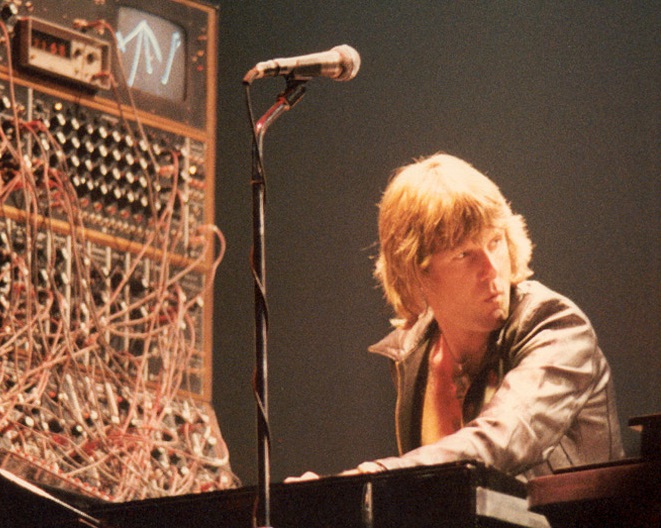
Keith Emerson performing in Buffalo, NY, in February 1978. Photo: Alfred Dominic Ligammari II
This blog entry provides an appreciation of Keith Emerson’s playing and musicianship, especially with the Moog Modular synthesizer, and points out some of the ways in which he was an exceptional synthesist. My thanks to Brian Kehew for contributing his insight and know-how. – Thom Holmes
Keith Emerson was an impeccably talented pianist whose vision for music generously encompassed the genres of progressive rock, classical, and jazz. Trained on the piano at an early age by local teachers, he recalled practicing arpeggios at age 8 while his friends banged on the window from the outside of his house. ¹
Never university trained, he progressed on his own while picking up licks listening to classical, blues, rock, and jazz music. As a young man, he took piano lessons from “three teachers” and branched out into composing. His knack for playing out-of-the-ordinary classical works came at the urging of one of his teachers, Carol Smith. Whenever Emerson wanted to learn something standard, like Tchaikovsky’s first piano concerto, she would dissuade him. “Don’t do that. Everybody does that,” recalled Emerson. “I always took a diverse approach to classical adaptations.” ²

Keith Emerson in concert: Tuscaloosa, Alabama, 1974. Photo credit: Mark Hockman; Bob Moog Foundation Archives
Beginning with the piano, he next added the Hammond organ and then the Moog to his repertoire of keyboards. His outside interests were broad and included things other than music — customizing motorcycles, running marathons (he ran four of them, including the New York Marathon), and piloting among them. But music was the core of his being.
Thom Holmes has a podcast, The Holmes Archive of Electronic Music. Listen to his exploration of this same topic here:
An imaginative player, he effortlessly combined elements of classical, rock, and jazz, and was able to play different styles on each hand at the same time. In many ways, one of the key drives behind his playing was that of contrast, and his flair for combining forms from various genres of music made this so easy for him.
With The Nice (1967-70), Emerson played the piano and Hammond organ and focused largely on his comprehensive amalgamation of rock and classical styles. Works such as “Rondo,” “The Cry of Eugene,” “The Thoughts of Emerlist Davjack,” and “Intermezzo from the Karelia Suite” characterized The Nice as having successfully brought the excitement of rock to works that would be known to classical music fans. With Emerson Lake and Palmer, Emerson and his new band mates, Greg Lake (vocals and bass) and Carl Palmer (drums), became spectacularly popular. Without a lesser role for lead guitar in the group, much of the musical weight fell on Emerson’s keyboard work. The music was over the top and dazzling, and success gave them license to explore their own compositions and to push the instrumentation, stylings, and arrangement of rock to its limits.

Keith Emerson at soundcheck
The early 1970s was a period when new rules were being applied to music and Emerson embraced that philosophy with fervor. He combined flashy but intelligent playing with a flair for the melodramatic in stage performance. By the time ELP’s second album arrived in 1971, Emerson’s significance as a composer and player were already evident:
“The songs are strange, but Emerson, Lake and Palmer are as complex as they are strange, and Emerson is a genius. He composed most of the things on both sides of the album, and he plays the Hammond Organ, the St. Marks Church Organ, the piano, the celeste (Tchaikovsky would have loved him) and the Moog Synthesizer. This is why his name comes first.” ³
The Moog Modular synthesizer was an important component of this new sound.
A SHORT HISTORY
The end of The Nice and the inception of ELP coincided with Emerson’s first exposure to the Moog Modular Synthesizer. In March of 1970, while leaving The Nice, Emerson learned of the Moog Modular from Mike Vickers, who was the London distributor of the instrument. He recruited Vickers to make the patching changes while Emerson played the instrument in a live performance by The Nice. Soon after, Emerson left the group to start ELP and with his record advance purchased his own Moog Modular in 1970. With help from Vickers, Emerson managed to squeeze out a few sounds that were added to their first LP. The Moog made a dramatic debut on their first album, Emerson Lake & Palmer (1970) in the final section of the song “Tank” and the iconic solo in “Lucky Man.”
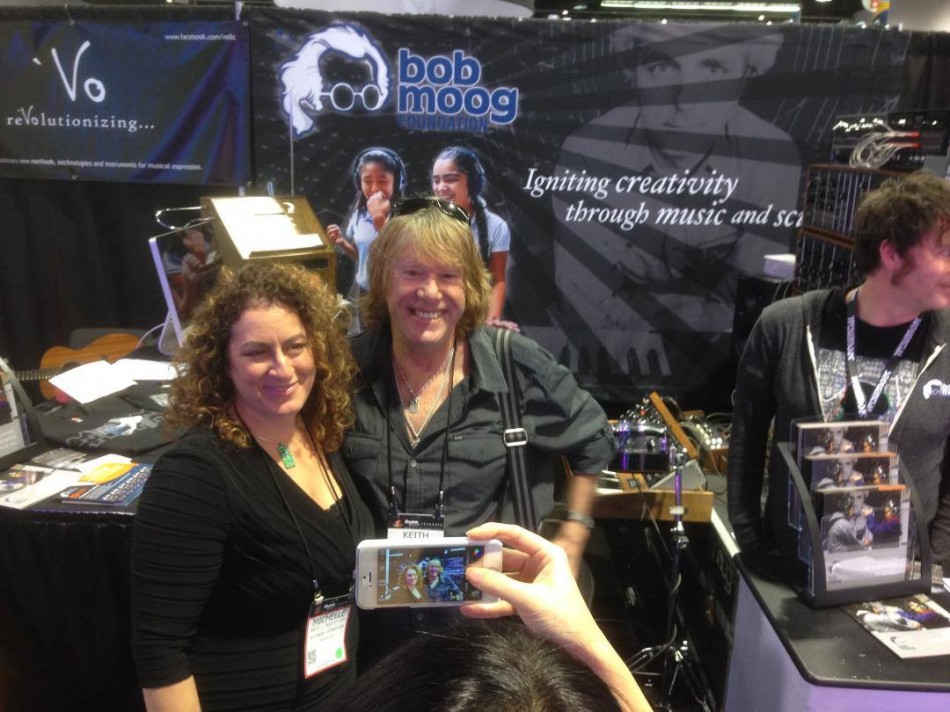 Keith Emerson with Michelle Moog-Koussa in 2015
Emerson continued to use the Moog Modular on five studio albums dating from 1970 to 1973. By the fifth, Brain Salad Surgery (1973), he had also adopted the Minimoog and at least two other Moog products; the prototype Apollo polyphonic keyboard and the Lyra monophonic synthesizer. By 1977, however, the Moog company had been sold and with his friend Bob Moog out of the picture, Emerson turned to instruments made by Yamaha (the GX-1) and Korg (PS-3300). With these keyboards, he was able to more fully explore polyphonic synthesis on ELP’s last albums before breaking up; Works Vol. 1, Works Vol. 2 (1977) and Love Beach (1978).
KEITH EMERSON THE MOOGIST
“I still use this [Moog Modular] as part of my keyboard rig because nothing else makes a sound like it. When you crank it up in a stadium, it can hurt.” (Emerson, 2014). ⁴
To discuss Keith’s playing, I reached out to Brian Kehew, a producer and musician who should be well-known to all Bob Moog Foundation supporters. Brian has been an archivist for the Bob Moog Foundation, and figured significantly in the revival and reconstruction of the “Emerson Moog Modular” in 2014. Brian’s view of Emerson’s aptitude with the Moog provides a distinctive perspective on this topic.
Here’s a link to the story of the Emerson Moog Modular System from 2014 in which Brian figured prominently: https://www.youtube.com/watch?v=G7TJyPAyTiQ.
Most Moog players approach the instrument as simply another keyboard, a “glorified organ” as Brian likes to say. This is fair to say for some players, but not for the Moog Modular itself, which had “huge range” if one knew how to patch it and extract imaginative sounds. ⁵

Bob Moog and Keith Emerson at Rich Stadium
The Minimoog became available in 1970, and by 1971 it had essentially supplanted the Moog Modular as the instrument of choice for most working musicians. Chick Corea, Herbie Hancock, Jan Hammer, and Rick Wakeman all found the Minimoog easy to work with because it allowed them to enhance individual notes using their existing keyboard skills, the core of expression for these players.
Brian calls this “note-oriented” playing “using patches, simple routings not much beyond what an organ could do.” The Minimoog had an organ-style keyboard equipped with a Modulation wheel (to vary the inflection of the tone) and a Pitch wheel (to slide the note), gestural control within the reach of any keyboardist. It was an instrument designed around adding expression to the note, a feature that jazz and rock artists appreciated.
“Keith did play melody-based synthesizer sounds mainly, as did most,” adds Brian. He was not a synthesizer expert; he did not really know all of what and why the synthesizer operated, as did Carlos and Tomita. Very few synthesizer owners really understood their systems well, but they “got on with it” and made music, as did Keith.” As Bob said, Keith took virtually anything and made it musical.
But with a full Moog Modular system at this disposal, “Emerson sometimes went beyond with wild modulations,” says Brian. This makes much of what Emerson did unique to his instrument and his patches. Bob Moog was amazed at Emerson’s ability to quickly translate what he was learning into something artistic.

Emerson with his “Monster Moog” synthesizer, May 2010. Photo: Mari Kawaguchi
“One of Keith’s great talents,” Moog once said, “is to approach a new electronic instrument and without anybody explaining too much about it, to turn the knobs and flip a few switches to see what happens, and then immediately get an idea of what can be used musically.” ⁶
Emerson’s broad musical experience was probably partly responsible for his sense of musical invention with electronic keyboards. Just how to use a synthesizer seemed to come more easily to those who were around jazz and classical music all their lives. Bernie Worrell was another case in point who recognized this:
“When the synthesizers came about, my having been brought up classically and knowing a full range of orchestra, tympanis and everything, I knew how it sounded and what it felt like. So, if I’m playing a horn arrangement on keyboard, or strings, it sounds like strings or horns, ’cause I know how to phrase it, how a string phrases, different attacks from the aperture for horns, trumpets, sax or trombones.” ⁷
Toccata (Brain Salad Surgery, 1973)
Toccata is our first example of a wild modulation. “The sound modulates in two different directions at once,” remarks Brian. “This is, without a doubt, pretty exceptional.”
Link to Toccata: https://www.youtube.com/watch?v=iFbJQ65xJSg
Brian provides the following guide to the track:
This is a tricky piece, as some of this is Lyra horn melodies (Lyra was a Moog prototype instrument), some parts are synthesizer triggered by drums–the solo drums over synth. And also some synth tracking Greg’s guitar. But the main noisy lead line here is that interesting patch that glides in two directions.
0:30 Most of the introduction is the Lyra, but at :30 seconds the modular plays. — the last note slides quickly in two directions, up and down.
1:12 It’s hard to hear but it’s a basic note/pitch that slide both up and down simultaneously, using an LFO that is a square wave (it jumps up/down in a trill). For a few seconds, Emerson demonstrates this quite well. So each pitch is trilling quickly up and down, while sliding outward from the center pitch in mirrored movement. I love it — great idea. Totally an unknown territory musically.
1:39 You can hear the square-wave trill modulation more clearly.
2:31 More of the same.
That sound is interesting as it utilizes the rarely-used Trigger Delays to activate the rise/fall motion only after he holds a key for a bit. So he can play normal notes and parts, then on the end of a phrase he can activate the wild rise/fall when he holds one down. There’s also some kind of ring modulator going to make it even more grindy! I think these sounds are some of the reasons his “lead keyboard” style held its own; he didn’t always use just a simple patch, he gave it complexity that rivals any acoustic or amplified instrument.
Aquatarkus (Welcome Back My Friends to the Show That Never Ends ~ Ladies and
Gentlemen, 1974)
A variation of this kind of modulation plus Emerson’s “great expansive sonics” can be heard on this live performance LP. “Aquatarkus” was a part of the live Tarkus concert piece.
Link to Aquatarkus: https://www.youtube.com/watch?v=Njbx8wJ78Qg
2:22–6:16 Emerson solos using various synthesizer voicings over an extended, modulating drone underneath.
8:26–8:58 Keith uses weaving drones and modulation to create fireworks of sound, not tonal melodic playing as much as sonic expressionism (Brian).This sequence simultaneously features Modular tones that are slowly rising in pitch, contrasted to sharp solo tones that cascade lower.
Mass (Welcome Back My Friends to the Show That Never Ends ~ Ladies and Gentlemen,
1974)
In this example, Emerson finds a glitch in the Moog ribbon controller and turns it into a tool. “Mass” is another part of the Tarkus taken from their live recording.
Link to “Mass”: https://www.youtube.com/watch?v=AhYBq6Iz2nQ
9:00 Brian: Keith solos using the ribbon/linear controller. It’s an incredible freakout, finding the between-pitches sounds keyboards do not usually make. He’s using a glitch in the material of the ribbon to create a machine-gun stuttering, while sliding pitches around manually with the ribbon.
Link to another performance of Mass: https://www.youtube.com/watch?v=tomMmkYzNgk
This video not only features a longer version of the glitchy ribbon solo, but an improvised part that makes use of several Moog modules at the same time.
9:18 Another version of the ribbon glitch and solo. Longer! (Brian)
19:47 Beginning of another great sequence of experimental sound, bass, ribbon controller and modulated white noise. “Shifting between the thick bass sound and the percolating drops of sound and noise,” explains Brian. “He really did these improvisations all the time, very fascinating use of the range of the Moog!” (Brian)
“From the Beginning” (Trilogy, 1972)
We have a recollection from Keith about the Minimoog. For the Trilogy album, he provided a beautifully lyrical Minimoog solo for the otherwise acoustic track, “From the Beginning.”:
“One thing I remember about making Trilogy,” Emerson explained, “is I played the solo of my life on the Minimoog … Getting it in tune was always a challenge. It was 4 a.m. and after playing the solo, I listened back to the tape and said to the engineer ‘Where’s my solo?’ I could tell by the stunned look on his face that it wasn’t there. He said ‘Umm, I thought it was there.’ I said, ‘You’ve wiped it off, haven’t you?’ It was the middle of the night and the engineer was very tired. But Greg stepped in and said ‘Oh, come on Keith, you can do another one.’ I said, ‘At 4 o’clock in the morning?’ So I did another one. Even now when I listen back to it, it’s okay, but it’s just slightly out of tune.” ⁸
Keith Emerson’s musical legacy is one of seamlessly crossing borders between genres. As Brian says, Emerson’s music was “really experimental. While most musicians usually lie in one camp or the other– tonal and tuneful or non-tonal experimental. Keith was pretty great at both, and not afraid to go there.”
We hope that this blog adds some tidbits to what you already know and love about Keith Emerson. We know that we’ve only touched the surface of his music-making. We urge you to discover more and to let us know what you appreciate about his music.
You might also want to read Michelle Moog-Koussa’s personal recollection of Keith Emerson.
Listen to Thom Holmes’ podcast, The Holmes Archive of Electronic Music, here.
1 Emerson, Keith. Pictures of an Exhibitionist: From the Nice to Emerson Lake and Palmer—The True Story of the Man Who Changed the Sound of Rock. London, John Blake, 2004, 15.
2 Prasad, Anil. Keith Emerson: Meshing Sonorities. Interview in Innerviews: Music Without Borders. 2015.
http://www.innerviews.org/inner/emerson.html
3 Walter Borawski. Emerson, Lake and Palmer Are, Frankly, a Little ‘Strange.’ Syndicated review of Tarkus as appearing in the Poughkeepsie Journal, June 27, 1971, 8A.
4 Keith Emerson, quoted in the video documentary, 50th Anniversary of the Moog Modular Synthesizer. Published on Oct 11, 2014. https://www.youtube.com/watch?v=G7TJyPAyTiQ
5 Brian Kehew. In correspondence, March 30, 2017. “Most Moog players used it as ‘a glorified organ’ – a commonly dropped criticism, but one really unfair considering the huge range of the instrument.”
6 Bob Moog, quoted in the video documentary, 50th Anniversary of the Moog Modular Synthesizer.
Published on Oct 11, 2014. https://www.youtube.com/watch?v=G7TJyPAyTiQ
7 Bernie Worrell, website: http://bernieworrell.com/bio.html
8 Prasad, Anil. Keith Emerson: Meshing Sonorities. Interview in Innerviews: Music Without Borders. 2015. http://www.innerviews.org/inner/emerson.html